How to Choose the Best Kitchen Food Storage Containers

Time:2026-09-15 Author:Madeline
0%

Choosing the right Kitchen Food Storage Containers is more than matching sizes and colors. It affects freshness, safety, kitchen space, and household waste. The United Nations Environment Programme’s Food Waste Index Report 2024 estimated that households generated 631 million tonnes of food waste in 2022. That figure gives storage decisions real weight. A weak lid can leave sliced fruit dry, while a poor seal can spread odors through an entire refrigerator.

Professional guidance also makes container selection less casual. The USDA, FDA, and Cornell University’s FoodKeeper resources emphasize timely refrigeration, safe temperatures, and suitable storage conditions. Their recommendations support practical features, including leak-resistant lids, clear labels, freezer compatibility, and materials intended for food contact. Glass can help with visibility and odor resistance, while lightweight plastic may suit packed lunches or crowded shelves. Neither option is perfect. That deserves a second look.

This guide examines Kitchen Food Storage Containers through everyday use, not attractive packaging alone. It considers portion sizes, stackability, microwave and dishwasher claims, lid durability, and cleaning access around corners. A container that stacks neatly but traps moisture may create new problems. A beautifully transparent box may still fail if its seal weakens after repeated washing. Market research reports continue to show strong consumer interest in convenient and sustainable food packaging, yet purchasing trends do not replace careful testing. The best choice depends on your refrigerator, cooking habits, budget, and tolerance for maintenance. Small details matter. The right container should protect food, reduce avoidable waste, and remain dependable after many ordinary kitchen routines.
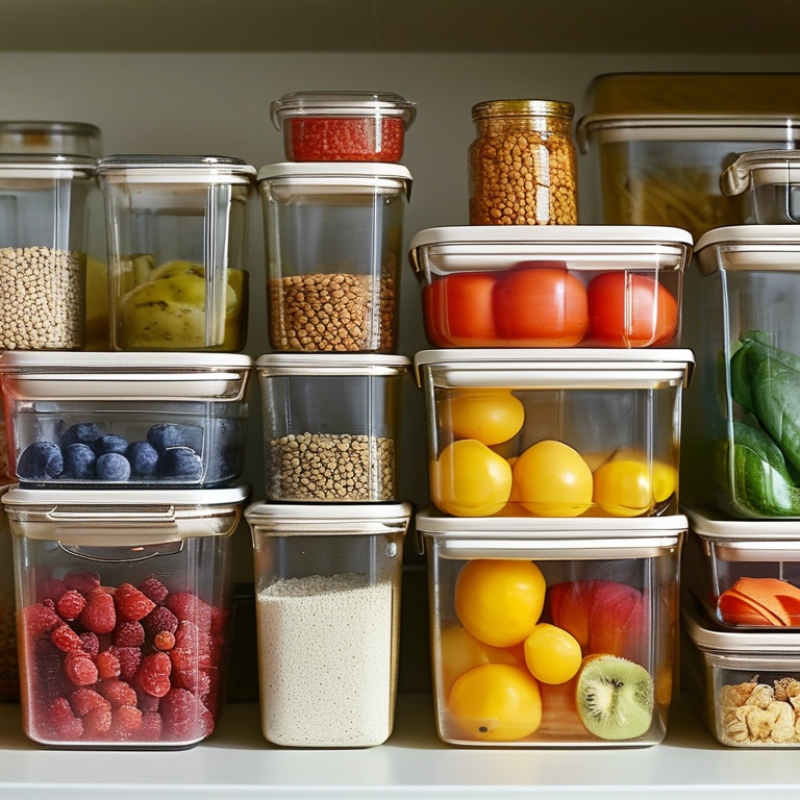
How to Choose the Best Kitchen Food Storage Containers

Select Materials Under FDA Food-Contact and 41°F Storage Standards

Choosing kitchen food storage containers requires more than checking size and appearance. The material must be suitable for food contact under its intended conditions. Look for a clear compliance statement covering applicable FDA food-contact requirements. “FDA approved” can be misleading because the FDA generally evaluates materials and uses, not entire containers. Good documentation should identify the material, temperature limits, and intended contact with foods.

For refrigerated perishable foods, maintain storage at 41°F or below. Use a refrigerator thermometer, because the door shelf may run warmer than the back shelf. A tight seal helps prevent leaks and reduces exposure to air, but it cannot correct unsafe cooling practices.

Divide hot food into shallow containers before chilling. Leave room for circulation around each container.

Material choice matters during repeated use. Glass handles temperature changes well, but it can break after a sharp impact. Food-grade plastic is lighter, yet scratches may trap residue and odors. Stainless steel is durable, though it is unsuitable for some microwave uses.

Always follow the container’s stated temperature range. Do not assume a freezer-safe label permits direct transfer into a hot oven.

Inspect
Before Buying

I used to focus on convenient shapes. That was incomplete. Now I inspect lids, seams, scratches, and cleaning instructions before buying.

A container with a reliable seal, readable labeling, and traceable material information is usually the safer long-term choice. Inspect it regularly. Replace damaged pieces.

Use USDA’s 3–4-Day Leftover Guidance to Size Containers

How to Choose the Best Kitchen Food Storage Containers

Use USDA’s 3–4-Day Leftover Guidance to Size Containers

The USDA advises refrigerating leftovers within two hours and eating them within three to four days. Keep your refrigerator at 40°F or below. This simple rule should guide container size more than appearance. Choose containers that hold one meal, not an oversized family portion. A 2-cup container suits soup for one person, while a 4-cup container fits a shared dinner. Leave a little headspace for sauces and expansion.

In my kitchen, shallow containers cool leftovers faster and make forgotten food easier to see. That matters because USDA food-safety guidance favors rapid cooling and cold storage. The EPA’s 2024 wasted food report also connects discarded food with unnecessary landfill methane emissions. Better sizing can reduce both waste and refrigerator clutter. Glass or durable plastic can work, but check whether each container handles heat, freezing, and repeated washing. I still overfill containers sometimes. That habit needs correcting.

Tips: Label the cooking date, not just the food name. Use a three-day reminder for delicate dishes, such as rice, poultry, and creamy sauces. Store one serving per container when possible. This makes reheating easier and limits repeated warming. If leftovers smell unusual, feel slimy, or exceed the recommended storage period, discard them. A container cannot make old food safe.

Compare Airtight Seals Using ASTM Leak-Resistance Test Methods

When choosing kitchen food storage containers, do not trust the word airtight alone. The seal should survive handling, temperature changes, and repeated washing. ASTM F2096 uses internal pressurization and bubble observation to identify gross leaks. ASTM D3078 applies bubble-emission principles to flexible packaging. These standards do not automatically certify every rigid container. A qualified laboratory should confirm the method’s suitability and document pressure, dwell time, temperature, and leak criteria.

For a household container, ask whether the test represents real use. A laboratory can close the lid, apply controlled pressure, and inspect submerged seams for continuous bubbles. Consumers should not attempt pressure testing at home. Do not confuse one trapped air bubble with an active leak. Repeat testing after opening and closing the latch many times. Check the gasket corners closely. They often reveal uneven compression.

In practical evaluations, a lid may pass a short test yet loosen after repeated washing. That limitation matters. One test is never enough. Compare results from unused containers and containers exposed to realistic handling. Record any slow bubbling, warped lids, or stiff latches. A reliable assessment should explain the test’s limits, not hide them. I would also question results that report only “passed” without pressure, timing, or failure details. Clear evidence makes the container easier to judge.

How to Choose the Best Kitchen Food Storage Containers - Compare Airtight Seals Using ASTM Leak-Resistance Test Methods

The table below compares common closure designs and provides an ASTM-referenced screening framework. ASTM packaging leak tests should be performed by a qualified laboratory with fixtures validated for the specific container and lid geometry.

Evaluation Dimension Snap-Fit Lid with Silicone Gasket Screw-Top Lid with Gasket Four-Sided Clamp Lid with Gasket Press-Fit Lid Without Gasket Lid with Integrated Vacuum Valve
Primary sealing mechanism Compression of a continuous elastomeric gasket Thread engagement combined with gasket compression Mechanical clamps apply compression at multiple points Interference fit between the lid and container rim Gasket seal plus a one-way valve that removes or retains air
Typical airtight performance Good when the gasket is seated evenly and the rim is undamaged Good to very good when threads are clean and fully engaged Very good when all clamps close with balanced force Limited; generally better for short-term containment than long-term airtight storage Potentially very good, but performance depends on valve integrity and operating technique
Most important leak path Folded, twisted, displaced, or compressed gasket Cross-threading, damaged threads, or a pinched gasket Uneven clamp force, worn gasket, or corner distortion Warped rim, poor dimensional fit, or lid deformation Valve seat, valve membrane, gasket, or lid interface
Best use case Everyday leftovers, dry foods, and refrigerator storage Liquids, soups, marinades, and transport where orientation may change Longer storage, bulk foods, and applications requiring strong lid retention Dry ingredients and short-term refrigerator storage Foods where reduced air exposure is useful, subject to safe food-storage practices
Liquid spill resistance Good with a continuous gasket and correctly closed lid Good when the lid is fully tightened without cross-threading Very good when every clamp is completely engaged Low to moderate; not the preferred design for transport of liquids Good if both the primary gasket and valve remain sealed
Cleaning requirements Remove and clean the gasket channel to prevent residue buildup Clean threads and gasket; inspect for trapped food particles Clean hinges, clamps, gasket, and corners thoroughly Usually simpler because there is no separate gasket or valve Clean the valve components according to the container instructions
Inspection before use Check for cuts, flattening, gaps, and incorrect gasket placement Check thread condition, gasket seating, and complete rotation Check clamp alignment, hinge condition, and gasket continuity Check the rim and lid for warping, cracks, or permanent deformation Check valve cleanliness, membrane condition, and gasket seating
Recommended ASTM-referenced screening method ASTM F2096 or ASTM D3078, using a validated fixture for the rigid container ASTM F2096 or ASTM F2338, with the lid installed at the specified torque or closure condition ASTM F2096 or ASTM F2338, with all clamps closed in the intended sequence ASTM F2096 or ASTM F2338 may be used for comparative screening, but fixture fit is critical ASTM F2338 is useful for non-destructive vacuum-decay screening; validate the valve separately
Practical selection recommendation Balanced choice for routine kitchen use Strong choice when liquid containment and transport are priorities Strong choice when maximum lid retention is more important than convenience Choose mainly for dry foods and low-risk storage conditions Choose when air reduction is needed and the valve can be cleaned and maintained

ASTM Leak-Resistance Test Comparison

ASTM Method Test Principle Leak Type Detected Useful Output Important Limitation
ASTM D3078 The package is placed under water while internal pressure is applied; escaping air forms visible bubbles Gross leaks and visibly leaking seal areas Pass/fail result and approximate leak location Originally intended for flexible packaging; rigid food containers require a suitable validated fixture and procedure
ASTM F2096 Internal pressurization is used while the package is submerged or otherwise observed for bubble emission Gross leaks in package walls and closure interfaces Visible leak indication and approximate leak location Test pressure, immersion conditions, and acceptance criteria must be defined for the container design
ASTM F2338 The package is placed in a chamber and evacuated; pressure change is monitored during the vacuum-decay cycle Leaks that produce a measurable change in chamber pressure Quantitative pressure-decay signal and pass/fail decision Requires equipment calibration, a suitable chamber fixture, and a validated product-specific limit

Selection rule: For most kitchens, choose a container with a continuous, removable gasket and a lid that closes evenly around the entire rim. Confirm leak resistance with the same fill level, closure condition, temperature, test pressure, and inspection time for every design being compared.

Optimize Shapes Against Measured Shelf, Drawer, and Cabinet Dimensions

Choosing kitchen food storage containers starts with measuring your actual storage spaces, not guessing from labels. Measure the clear width, depth, and height of each shelf, drawer, and cabinet. Include hinges, runners, handles, and shelf lips. A container may fit on paper but fail when a door closes.

Rectangular containers usually use shelf space better than round ones. Their straight sides reduce unused gaps and create stable stacks. For deep drawers, choose low, wide containers that remain visible from above. Tall containers suit cabinets, but leave enough clearance to lift the lid. I recommend keeping a small air gap around stacked containers for easier handling. In my own kitchen, I bought a container that matched the shelf height perfectly. The lid made it unusable. That mistake changed how I measure.

Tips: Record the smallest measurement, not the largest. Test cardboard boxes first. Mark the interior dimensions with removable tape. Choose matching footprints for cleaner stacking, but allow different heights for grains, leftovers, and narrow ingredients. Transparent walls improve visibility, although labels still help in dim cabinets. Leave room for your hands. A packed shelf often looks efficient but becomes frustrating after one busy meal. Recheck measurements after installing shelf liners, because they can reduce usable height slightly.

Evaluate Reuse and Recycling Through EPA Food-Waste Data

How to Choose the Best Kitchen Food Storage Containers

EPA food-waste data shows why container choice deserves more attention. A container can prevent forgotten leftovers, but it cannot rescue food already wasted. EPA guidance places reducing food waste above recycling or disposal. Clear containers help me see cooked vegetables before they become refrigerator fossils. Small sizes also discourage oversized portions.

Reuse usually performs best when one container survives years of washing and daily handling. Choose sturdy, food-safe materials with tight lids, simple shapes, and replaceable seals when possible. I have overestimated my storage needs before. Large containers looked practical, but they often hid small portions behind taller items. A modest container used repeatedly can be more useful than a recyclable container used once.

Recycling still matters, but its success depends on local facilities and accepted materials. Check your community’s recycling rules instead of trusting the recycling symbol alone. Wash containers thoroughly, remove food residue, and separate lids when required. EPA data emphasizes that recycling ranks below preventing waste, so packaging claims should not guide the entire decision. Washing reusable containers also uses water and energy, especially during frequent hand cleaning. That trade-off deserves honest attention. A dishwasher may improve efficiency, but only when the container is designed for it.

FAQS

How can I judge whether a food container is truly airtight?

Do not trust the word “airtight” alone. The seal should survive handling, temperature changes, and repeated washing. Look closely at gasket corners. Uneven compression often appears there.

What laboratory test can reveal a gross leak?

A laboratory may apply controlled internal pressure and inspect submerged seams for continuous bubbles. One trapped bubble is not necessarily an active leak. Test pressure, timing, temperature, and leak limits should be recorded.

Can I pressure-test a container at home?

No. Home pressure testing can create unnecessary risks. Use normal handling checks instead. Watch for loose lids, damaged gaskets, or moisture inside the seal.

Why should containers be tested after repeated opening and closing?

A latch may pass a short test but loosen later. Repeated use can change gasket compression. Test unused containers and heavily handled containers separately. The comparison may expose problems.

What details should a reliable leak report include?

It should state the pressure, dwell time, temperature, and failure criteria. A simple “passed” statement is incomplete. Slow bubbling and warped lids deserve specific notes.

How do clear containers help reduce food waste?

Clear walls make leftovers visible behind refrigerator shelves. Small containers can discourage oversized portions. Still, visibility cannot save food that was already forgotten.

What features support long-term reuse?

Choose sturdy, food-safe materials with tight lids and simple shapes. Replaceable seals can extend useful life. I have overestimated storage needs before. Large containers sometimes hide small portions.

How should reusable containers be recycled?

Check local recycling rules before relying on a recycling symbol. Wash away food residue and separate lids when required. Recycling systems differ. Reuse may still use water and energy during frequent washing.

Conclusion

Choosing the best Kitchen Food Storage Containers requires more than comparing appearance and price. Start by selecting materials intended for food contact and suitable for storage at or below 41°F, while checking that the containers can handle your refrigerator, freezer, or reheating needs. Use the USDA’s general three- to four-day guidance for refrigerated leftovers to choose practical sizes, avoiding containers that are too large and leave excess air or too small to hold a complete portion.

Airtight seals should be assessed through leak-resistance performance, using testing principles associated with ASTM methods rather than relying only on marketing claims. Measure shelves, drawers, and cabinets before purchasing so the shapes fit efficiently and remain easy to access. Finally, consider long-term reuse, durability, and recycling options. Choosing containers that help preserve food, organize storage, and reduce avoidable waste supports more efficient household habits and aligns with broader food-waste reduction goals reflected in EPA data.


Madeline

Madeline

Madeline is a dedicated marketing professional with a wealth of expertise in our company's core offerings. With a keen understanding of the industry, she brings a unique perspective to her role, consistently delivering high-quality content that highlights the superior aspects of our products. As......